BSPT and BSPP are the two kinds of British Standard Pipe thread, and on site they look almost the same: the same 55° thread form and the same number of threads per inch in every size. What separates them is the shape of the thread and the way the joint seals. Getting it wrong is one of the most common reasons a threaded joint weeps or a fitting is sent back. This guide shows how to tell them apart in a few minutes with a caliper and a look at the marking.
1. The short answer
| BSPT (taper) | BSPP (parallel) | |
|---|---|---|
| Standard | ISO 7-1 (formerly BS 21) | ISO 228-1 |
| Letters on drawings | R (external), Rc (internal taper), Rp (internal parallel) | G |
| Shape | Tapered 1:16 on diameter | Straight, same diameter along the thread |
| Where it seals | On the thread itself, with PTFE tape or a thread sealant | On a face: washer, bonded seal or O-ring |
| Typical use | Pipe and pipe fittings: water, fire, gas, compressed air | Valve and pump ports, hydraulic and pneumatic adaptors, gauges |
| Thread angle and TPI | 55° Whitworth form and the same TPI per size in both | |
2. Read the marking first
Drawings, catalogues and valve bodies usually carry the thread letter, and it settles the question faster than any measurement:
- R: external taper thread, for example R 1/2 on a threaded pipe end or a nipple.
- Rc: internal taper thread.
- Rp: internal parallel thread made to ISO 7-1, designed to take an R taper thread and seal on the thread.
- G: parallel thread to ISO 228-1, which does not seal on the thread. G...A and G...B are the two tolerance classes for external G threads.
Rp and G are both parallel, but they are not the same thing. Rp is a pressure-tight thread meant to be used with an R taper thread; G needs a washer or seal on the face.
3. Look at how the joint seals
If the part has a flat face, a groove for an O-ring or a bonded washer, it is almost certainly BSPP (G). If it relies on tape or paste on the thread and has nothing to seal against, it is BSPT (R into Rc or Rp). Pipe fittings for water, fire and gas lines are normally taper-sealing; hydraulic adaptors and many valve ports are parallel.
4. Check for taper with a caliper
Measure the outside diameter of an external thread on the first full thread, then again about 16 mm further along. A taper thread is about 1 mm larger in diameter over that length, because the taper is 1:16 on diameter. A parallel thread measures the same at both points. For acceptance testing a thread gauge is used, not a caliper, but the caliper check is enough to tell the two apart on site.
5. Find the size: outside diameter and TPI
Once you know it is BSP, measure the outside diameter and count the threads per inch (or read the pitch with a thread gauge):
| Size | Major Ø, mm | TPI | Pitch, mm |
|---|---|---|---|
| 1/8" | 9.73 | 28 | 0.907 |
| 1/4" | 13.16 | 19 | 1.337 |
| 3/8" | 16.66 | 19 | 1.337 |
| 1/2" | 20.96 | 14 | 1.814 |
| 3/4" | 26.44 | 14 | 1.814 |
| 1" | 33.25 | 11 | 2.309 |
| 1 1/4" | 41.91 | 11 | 2.309 |
| 1 1/2" | 47.80 | 11 | 2.309 |
| 2" | 59.61 | 11 | 2.309 |
The full table up to 6 inch, with the NPT sizes beside it, is in the free BSP and NPT thread chart (PDF). For the background on each standard see the BSP thread guide.
6. Which thread does a malleable iron fitting have?
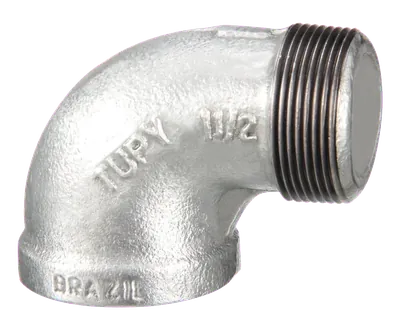
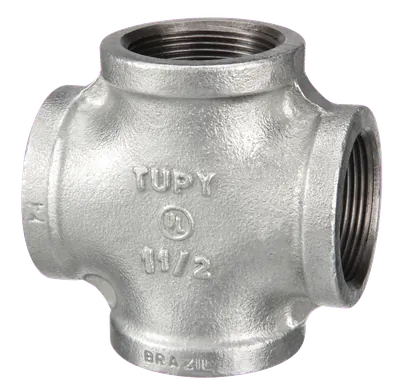
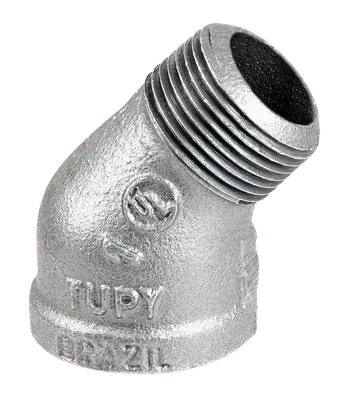
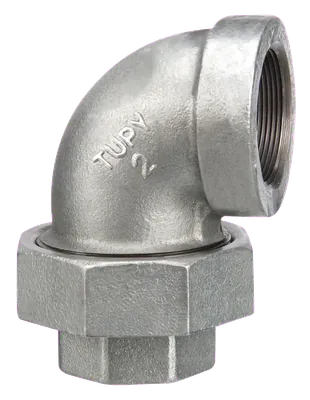
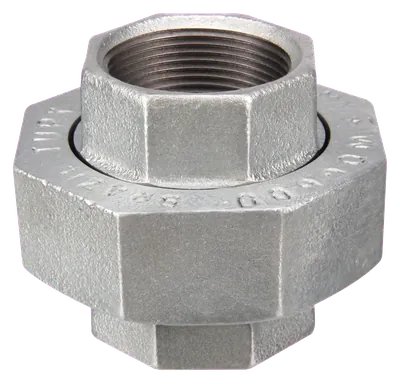
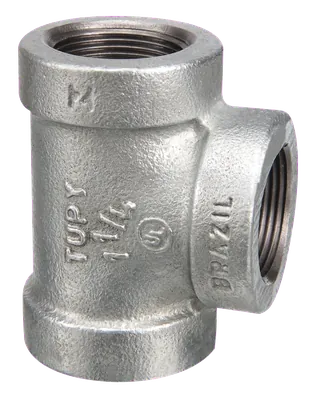
TUPY BSP fittings from Brazil have internal parallel pressure-tight threads (Rp) and external taper threads (R) to ISO 7-1. A pipe threaded with an R taper thread screws into the fitting and seals on the thread with tape or sealant, which is the normal joint for GI and black steel pipe in the Gulf.
If you are buying in the Emirates, see our pages for a GI fittings supplier in UAE and an MI fittings supplier in UAE; TUPY also makes the same figures in NPT for projects specified to American standards.
7. Mistakes we see on site
- Screwing a G (parallel) adaptor into an Rc (taper) port and expecting it to seal on the thread.
- Over-tightening a taper joint to stop a weep; with the wrong thread type it only splits the fitting.
- Mixing BSP and NPT in 1/2" or 3/4" because the TPI matches.
- Relying on PTFE tape on a parallel joint that was designed to seal on a washer.
Not sure which thread your project uses? Send a photo or the drawing on WhatsApp +971 56 950 9061 or to info@abmtgroup.com and we will confirm the thread and the matching TUPY figure, or use the request a quote form.